
By: Jamie Murray, CFA

Investors fear artificial intelligence could disrupt the technology sector. The evidence suggests it may strengthen it.
AI is wonderful. AI made this comic (after several re-prompts). However, the pace of improvement the technology is driving is beginning to worry investors. Artificial intelligence has quickly become one of the most powerful technological forces shaping the global economy. Its rapid advancement has delivered meaningful productivity gains and enormous wealth creation. Yet the same progress that excites technologists is beginning to unsettle investors.
As my colleague wrote last week, in his piece about the commoditization of white-collar work, markets tend to react negatively to uncertainty. When a new technology appears capable of reshaping entire industries, the first reaction is often fear that existing business models could become obsolete. Artificial intelligence is now triggering exactly that kind of response.
In recent months investors have begun asking a difficult question. Will AI simply improve productivity, or will it fundamentally disrupt the technology companies that built today’s digital economy?
That distinction matters greatly for markets.
The Acceleration of AI Infrastructure
The pace of improvement in artificial intelligence is extraordinary and much of that progress is being driven by advances in computing infrastructure.
Consider Nvidia, the company at the center of the AI ecosystem. Earlier AI systems typically connected eight GPUs together in a single rack. Nvidia’s newest Rubin platform connects eight racks, each containing seventy-two GPUs, into one integrated computing system. The next generation of architecture is expected to expand that capability even further.
These developments dramatically increase the computing power available for training and operating AI models. As the infrastructure scales, so does the capability of the technology.
The result is an accelerating cycle of innovation that continues to raise both expectations and concerns about how quickly AI could reshape entire industries.
Figure 1: Nvidia Rubin Platform Supercomputer

(Source: Nvidia)
Why Markets Are Nervous
Despite the technological excitement technology stocks have experienced significant volatility.
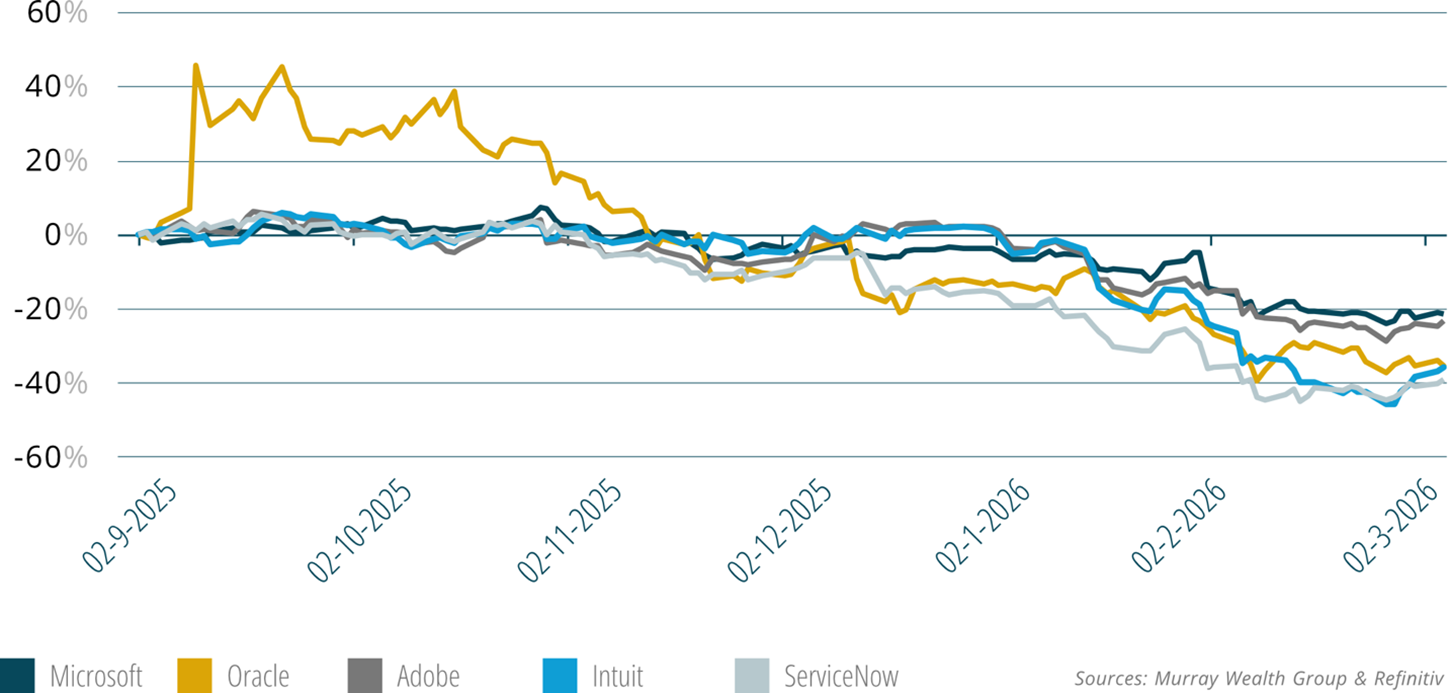
Many of the large technology companies leading the AI race have declined year to date and remain well below their highs reached in late 2025. At the same time software companies across the broader technology sector have fallen even further with some down between 35 and 45 percent from recent peaks.
The reason is not weak demand or deteriorating fundamentals. Rather the market is attempting to price in the possibility that AI could disrupt not only workers but also the companies that employ them.
Generative AI is already capable of writing code, performing administrative tasks and learning processes through repetition. Some investors fear that businesses or even individual users could eventually recreate software functionality at significantly lower cost.
In that scenario the economic moat protecting many software companies could weaken. This fear has led markets to reprice portions of the technology sector as if disruption is imminent.
Figure 2: Software Stocks Decline as Market Prices AI Risk
A Different Interpretation
While these concerns are understandable there is a compelling alternative interpretation.
Artificial intelligence may not replace the existing technology ecosystem. Instead, it may expand and enhance it.
AI systems still rely heavily on structured data, software platforms and distribution networks built over decades. Many of the most successful technology companies operate powerful aggregation platforms that connect buyers and sellers, users and services or enterprises and infrastructure.
Take Uber as an example. Its competitive advantage is not simply its software code. It lies in the network connecting drivers, restaurants and riders across thousands of cities. Competitors have repeatedly attempted to replicate the service with similar or even better technology, yet few have successfully matched the scale of Uber’s marketplace.
Artificial intelligence does not necessarily weaken these types of platforms. In many cases it could make them even more valuable.
Similarly, Jensen Huang, CEO of Nvidia, has suggested that the rise of agentic AI could increase software usage. If multiple AI agents assist each human worker software consumption could grow significantly rather than shrink. In other words, AI may not eliminate software demand. It may multiply it.
The Capital Spending Reality
Another important signal comes from the capital spending of the world’s largest technology companies.
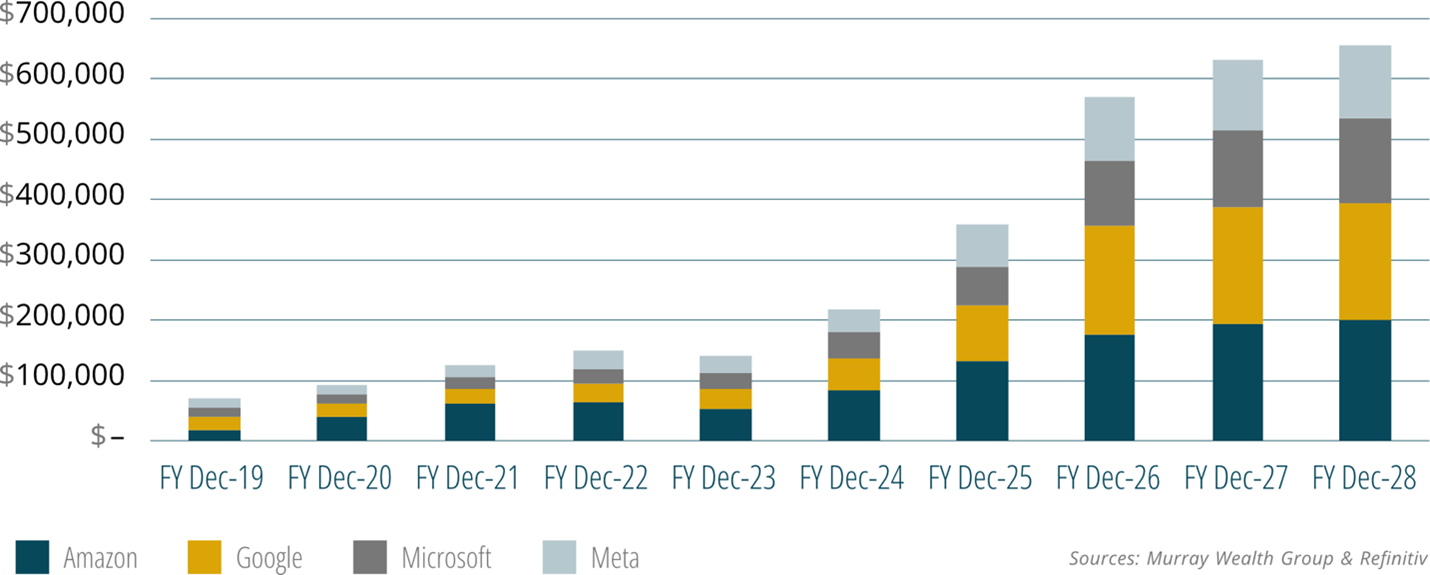
Microsoft, Amazon, Meta and Google are investing aggressively in data centers and AI infrastructure. Their capital expenditures have increased significantly and are expected to continue rising over the next several years. Yet despite these enormous investments earnings forecasts for these companies continue to rise.
Consensus estimates for 2028 earnings per share across these companies are higher today than they were six months ago. This suggests that the additional spending is not eroding profitability. Instead, it appears to be enabling new revenue opportunities and reinforcing competitive advantages.
Much of the infrastructure currently being built is not yet fully operational which means the economic impact of this investment may still lie ahead.
Figure 3: Capital Expenditures by Major Hyperscale Technology Companies
How We Are Positioning the Portfolio
At Murray Wealth Group we view artificial intelligence primarily as a productivity enabler. We expect it to support corporate profitability, drive economic growth and create new market opportunities across multiple industries.
Our portfolios remain focused on companies that are well positioned to benefit from this transformation. Large technology platforms such as Microsoft, Amazon, Meta and Google are deeply embedded in the global digital economy and operate critical infrastructure for businesses and consumers. These companies also benefit from trust and security relationships with enterprises that cannot easily be outsourced to independent AI agents.
Within the software ecosystem we also favor businesses that act as aggregators of supply and demand. Companies such as Uber and Amadeus IT Group sit at the center of global networks that become increasingly valuable as digital activity expands.
While we remain mindful of the risks associated with rapid technological change, we believe the long-term opportunity created by AI is far larger than the disruption currently being priced by the market.
The Bottom Line
Artificial intelligence will reshape many aspects of the global economy. Some business models will change, and certain industries will face disruption. History suggests that transformative technologies tend to expand economic opportunity rather than eliminate it.
For investors with a long-term perspective the key question is not whether AI will change the technology sector.
It will.
The real question is which companies are best positioned to benefit from that change.
Our focus remains on identifying those businesses and owning them through the cycles of excitement and uncertainty that accompany every major technological shift.