
Less than a decade ago, Netflix embarked on the international expansion of its eponymous video-on-demand streaming service, a significant shift from its DVD-by-Mail strategy that had delivered more than one billion DVDs to its members. Netflix’s success can be evidenced by its revenue growth, rising from US$2.2B in 2010 to US$20.2B in 2019. At the heart of this growth is the Flywheel strategy it uses to perpetuate its growth. Read
Category Archives: Market Insights
What’s Happening in the Oil Market?
Monday’s large market sell-off (S&P 500 Index down 3.3%) due to Coronavirus and U.S. Political concerns will be addressed in our February Portfolio Review next week. Our phone and email lines are always open if you have questions or would like to reach us personally.
What's Happening in the Oil Market?
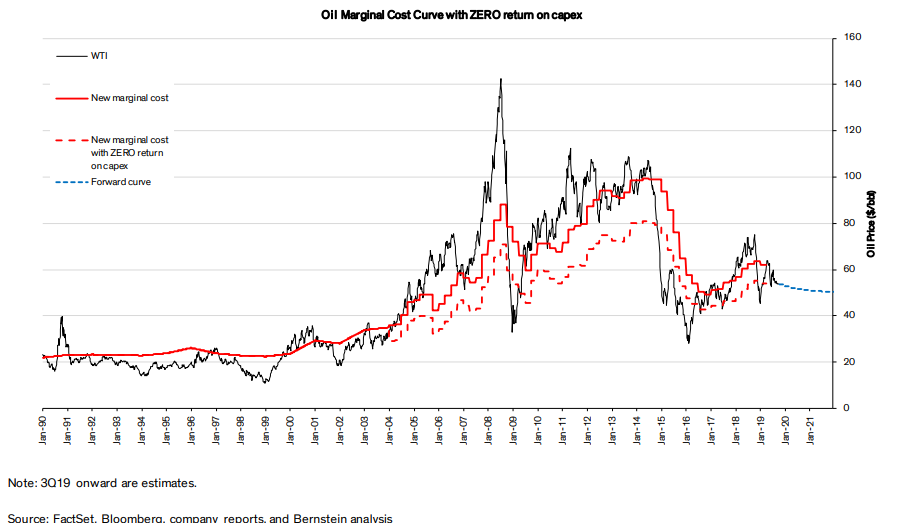
After its fall in 2014 from US$100+, oil prices have bounced between US$40-70/barrel (bbl) save for a few peaks and dips outside of that range. CNBC Commentator Jim Cramer called for the death of oil last week on his show Mad Money, saying these companies are un-investable due to the acceleration of climate change and an increasing focus on ESG (Environmental, Safety and Governance) changing investment trends. Recently, Blackrock committed to doubling its ESG friendly ETF offering and shunning companies that derive more than 25% of revenue from coal.
Oil and commodities are inherently cyclical. And while it’s true that oil is being replaced by other forms of cleaner energy, this trend has been ongoing for several decades. In 1990, oil consumption represented half of global energy consumption. Today, with millions of more cars on the road, global oil consumption is about 40% higher than it was in 1990, but down dramatically as a percent of total energy consumption to 34%.
Figure 1: Shares of Global Primary Energy Consumption by Fuel
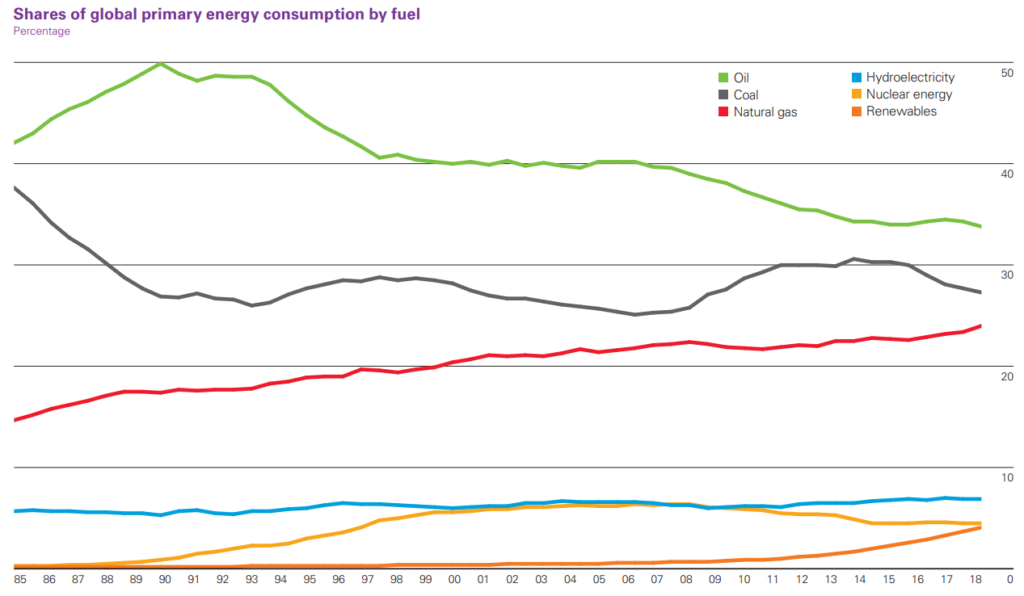
As noted above, while oil’s market share is declining, its absolute consumption is not. In 2018, consumption reached 100 million barrels of oil per day, a 1.5% increase year over year and an acceleration from the 1.0% average growth rate from 2007-2017.
To understand oil prices, we must look to the supply side and marginal cost. As can be seen in Figure 2, U.S. supply grew quickly from 2005-2015 before falling in 2016 as drilling activity fell, following but lagging the 2014 oil price correction. When oil prices rose, U.S. production responded quickly, with the U.S. adding a record 2.2 million bpd in 2018 (the largest increase in a year for a single country).
Figure 2: Global Oil Production Growth
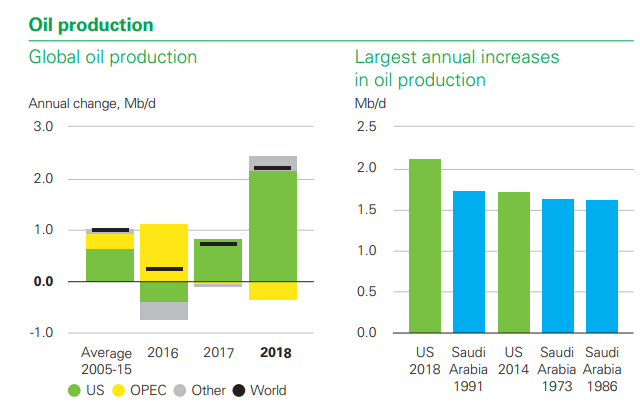
It is widely accepted that North American oil, particularly U.S. shale, is currently the marginal barrel of oil produced. According to Bernstein Research, the current marginal cost of oil is about US$60, slightly above current prices. Below marginal cost, producers are not incentivized to grow oil production. Assuming there is insufficient supply capacity below the marginal cost (i.e. some new large oil discovery that can be produced more efficiently than U.S. shale), we should see prices appreciate from here to spur drilling that will be required to meet growth in demand.
Figure 3: Marginal Cost of Oil VS Oil Price
Valuation.
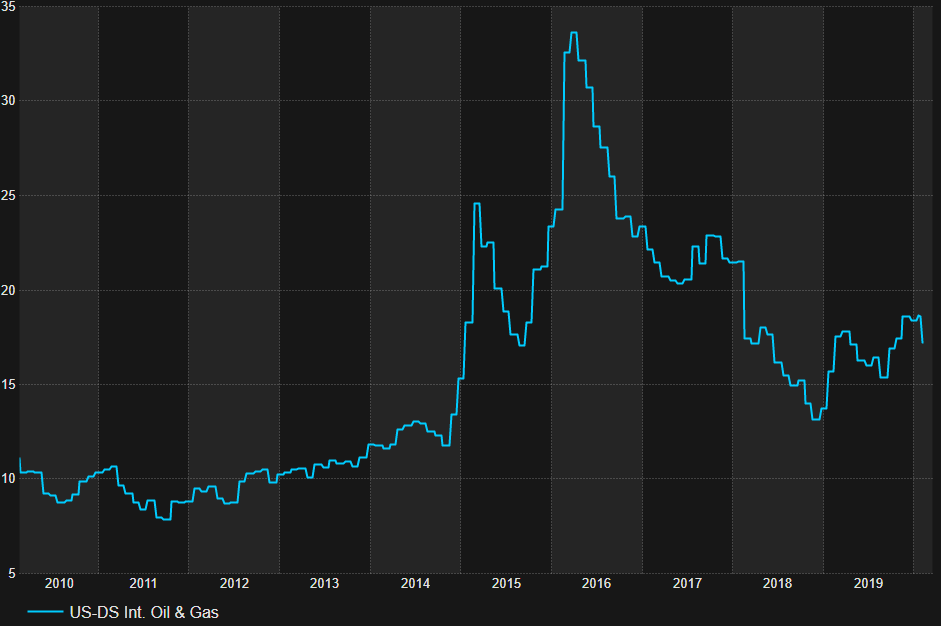
Two common valuation metrics for oil companies are the ratio of price to earnings or cash flow and a more technical discounted cash flow based on the company’s reserves and a forward price assumption (Net Asset Value or “NAV”). Both are commonplace but investors currently seem focused on near-term earnings/cash flow metrics. As shown below, the U.S. peer group is trading at a P/E multiple of approximately 17.5 times. This is actually a premium to multiples experienced earlier this decade (cash flow metrics showed a similar relationship), although we note that multiples tend to fall when oil prices significantly exceed the marginal cost, and valuations across equities are much higher today than they were in 2010-2013.
Figure 4: Composite P/E Ratio for U.S. Oil Exploration & Production Companies
On a NAV basis, valuations are much less demanding as the market has started to place discounts on corporate reserve values. We’ll use a former market darling in Canada, Whitecap Energy, as an example. In Feb 2019, the company reported the following NAV values. At the time, its share price was $4.29.
Figure 5: Price/NAV for Whitecap
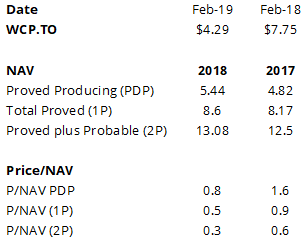
*NAV’s estimate the future value of a company’s reserves and are subject to geological estimations and future commodity prices. Reserves are categorized as follows: Proved reserves have a 90% chance of recovery. PDP – from producing wells, 1P – includes undeveloped reserves (i.e. future drilling), 2P – 50% chance of recovery.
Historically, Canadian oil companies have traded in line or at a premium to NAV based on proved and probable reserves (2P NAV as shown in the table above). For example, in 2014, Whitecap’s average share price was about $14.20 compared to a 2P NAV of $13.33. In 2015, following the oil price correction, investors started to place discounts on reserve values, essentially indicating they would not assign value to future production and cash flow, and thus oil stocks started trading more on the basis of proved producing reserves (PDP). At a P/NAV of 0.8x based on PDP, investors were indicating that the cash flow value of Whitecap’s currently producing wells (i.e., if the company did not drill another well ever) should be discounted at a rate higher than the standard 10% used by industry engineers.
Putting It All Together.
Tesla Inc. shares have tripled since the summer of 2019, indicating that the market is looking at a major shift in consumer behaviour with accelerated electric vehicle adoption in the near term. However, despite the excitement around electric vehicles, oil demand continues to increase. Oil cycles are shortening with advances in shale drilling, which enables a faster supply response.
We believe there’s a chance for an uptick in the oil market short term as the rate of decline in global base production is increasing as a result of constrained capital spending on the part of producers. However, higher oil prices (and gasoline prices) will serve to accelerate any shift to electric vehicles as economics shift to EVs. With more investors shying away from hydrocarbons due to ESG and other increasing anti-oil social pressures, it is difficult to see a re-rating of oil equities unless we see a change in sentiment.
This is the eighteenth in a series of independent research produced by the Murray Wealth Group Research Team.
The purpose of this series is to provide insight into our portfolio construction and how our research shapes our investment decisions.
We welcome any feedback or questions you may have on these monthly commentaries.
2020 Outlook
Market Priced Higher; Watch the Fed; Tech Continues to Eat the World; Five BOLD Predictions.
Lessons from Silicon Valley
Facebook’s Asian Opportunity
That in itself is not shocking. We are familiar with successful Chinese firms like Tencent (WeChat), ByteDance (TikTok), Alibaba and Baidu, Japan’s Softbank (how’s that WeWork IPO coming along?) and Indonesia’s GrabCar (essentially an Asian-version of Uber and motorbikes). However, the products and services of technology firms from the West remain very relevant for Asian businesses and consumers. Read
IBM: Signs of a turnaround afoot
Recession Watch 2019
What are indicators saying?
Recessions are almost impossible to predict. Consider these three headlines:
“US could go into recession this year: Expert”
“There’s more than 60% chance of a global recession within the next 18 months, economist says”
“The bond market’s recession signal may be wrong this time”
The year from each respective headline – In order: April 2015, April 2017 and July 2018. Read
Trade War Times: Where to Invest
The current trade war between China and the United States represents both a headwind for global economic growth and an overhang in the equity markets. A myriad of factors has driven the U.S. and China to this point, but there are two main issues that the U.S. Government is targeting: its large trade deficit with China, as well as concerns surrounding the transfer of intellectual property, state secrets and technology through espionage. Read
Midsummer Musings
This is the fourteenth in a series of independent research produced by the Murray Wealth Group Research Team. The purpose of this series is to provide insight into our portfolio construction and how our research shapes our investment decisions. We welcome any feedback or questions you may have on these monthly commentaries.
This piece is written by our CEO and CIO, Bruce Murray.
Midsummer Musings
While the American stock markets have recently broken through to all-time highs, we continue to see prognosticators fighting for seats atop the ‘Wall of Worry’.
“This is the longest economic expansion in history.”
“We are at full employment; therefore, inflation must be just around the corner.”
“The tariff wars have killed trade.”
On the other hand, Larry Fink of Blackstone believes that the U.S. public is underrepresented in equities despite the solid liquidity of the U.S. consumer.
Market Research #13: Antitrust
Antitrust Coming to Big Tech
This is the thirteenth in a series of independent research produced by the Murray Wealth Group Research Team. The purpose of this series is to provide insight into our portfolio construction and how our research shapes our investment decisions. We welcome any feedback or questions you may have on these monthly commentaries.
This piece is written by our Head of Research, Jamie Murray.
On May 31, The Wall Street Journal broke the news of the opening of an investigation into four of the most prominent technology companies: Alphabet, Amazon, Apple, and Facebook. The action is bi-partisan supported and thus ‘big tech’ won’t be able to lean on its friends in Washington for sanctuary. We own positions in all four companies in our Global Growth Portfolio as we are attracted to the technology sector’s appealing fundamentals (secular growth, strong margins, low capex/high cash flow). As owners, we are keenly interested in gauging the likely outcome of each company’s investigation and determining the risks and opportunities available.
Market Research #12: Aritzia
Aritzia: wide open space for U.S. growth
This is the Twelfth in a series of independent research produced by the Murray Wealth Group Research Team. The purpose of this series is to provide insight into our portfolio construction and how our research shapes our investment decisions. We welcome any feedback or questions you may have on these monthly commentaries.
Aritzia is a Canadian women’s fashion retailer positioned at the upper end of the mass consumer market. The company has a strong footprint in Canada with 67 locations, and a growing presence in the United States with 25 stores located in both shopping centers and other urban shopping destinations. Aritzia designs and sells exclusive inhouse brands, including TNA, Wilfred, and Babaton, and carries select products of leading designers such as Adidas. The company enjoys high satisfaction amongst the coveted 20-40 year-old women’s demographic. It is positioned above larger fashion retailers like H&M and The Gap but well below European luxury designers in terms of price, brand perception and quality. We believe Aritzia is a best-in-class fashion retailer, with a long runway of growth in the United States, trading at a reasonable valuation.
Market Research #011: Cruising Industry
Cruising to Strong Returns with Royal Caribbean

This is the Eleventh in a series of Independent research produced by the Murray Wealth Group Research Team. The purpose of this series is to provide insight into our portfolio construction and how our research shapes our investment decisions. We welcome any feedback or questions you may have on these monthly commentaries.
The cruise industry presents an attractive opportunity for investors. With the perception of cruising having changed over the last date, the industry has been expanding into both new geographic and demographic markets globally. China represents a strong new growth market as its middle class emerges, and new onboard features/entertainment options are appealing to millennials and families as alternatives to destination resort vacations. As well, cruise lines are now able to better maximize capacity utilization as the ships can be relocated to high demand markets based on seasonality.
The industry is dominated by three major players (Royal Caribbean, Carnival, and Norwegian) that combined make up 75% of the market (based on available capacity), with smaller, niche operators limited to certain markets or demographics. Barriers to entry are relatively high, with sales distribution, significant capital requirements, quality/reputation and port/berth access representing the main barriers to new competition. The last major company to successfully enter the cruise market was Disney, in the 1980s (although it remains a niche player with 2.2% share and Disney-themed ships), and it was only able to do so by leveraging its established brand as well as holiday distribution and marketing.
Market Research #010: Global Automotive Sector
Evaluating Investment Opportunities in the Global Automotive Sector
This is the Tenth in a series of Independent research produced by the Murray Wealth Group Research Team. The purpose of this series is to provide insight into our portfolio construction and how our research shapes our investment decisions. We welcome any feedback or questions you may have on these monthly commentaries.
The Global Automotive sector is a complex web of original equipment manufacturers (OEMS for short; Ford, Nissan, Tesla), suppliers and of course, customers, mostly retail, but also including trucking companies, rental car services and other commercial vehicle applications. Tangled into the physical asset chain is the financial aspect of lease/financing transactions, which have their own set of complexities.
The sector has seen major disruption throughout its history, starting with the introduction of assembly line manufacturing a century ago…..to the rise of Japan, Korea and now China in automotive production…..to an ever-increasing use of computing/technology. This report will outline where we stand in the auto cycle and how new disruptors will affect the investment landscape and opportunities, we see for good investment returns.
Market Research #001 – The Lost Decade: How to Make Money in Canada?
Answer: Diversify Away from It.
This is the first in a monthly series of Independent research produced by the Murray Wealth Group Research Team. The purpose of this series is to provide insight into our portfolio construction and how our research shapes our investment decisions.
Market Research #009 – Facebook: controversy in rear-view, growth resumes
-
- It is common for high growth companies to have flaws exposed in their business models as their products or services become more mainstream, attracting critics and detractors. We detail examples of two other high growth companies that faced similar controversy.
This is the ninth in a series of independent research produced by the Murray Wealth Group Research Team. The purpose of this series is to provide insight into our portfolio construction and how our research shapes our investment decisions.
Market Research #008 – 2019 Outlook
-
- For our monthly research note, we are presenting our 2019 investment outlook.
This is the eighth in a series of independent research produced by the Murray Wealth Group Research Team. The purpose of this series is to provide insight into our portfolio construction and how our research shapes our investment decisions.
Market Research #007 – Netflix: Large Market Provides Room to Grow
-
- One of our key considerations when investing in a company is that it represents an enduring growth opportunity. We believe markets generally underestimate the length of time that a company can sustain a high level of growth.
This is the seventh in a series of independent research produced by the Murray Wealth Group Research Team. The purpose of this series is to provide insight into our portfolio construction and how our research shapes our investment decisions.
Market Research #006 – Airbus: Big Airplane Backlog will Drive Upside
-
- Global airline travel continues to grow, leading to strong demand for new aircraft. Following excellent share price gains for rival Boeing, we think Airbus is best positioned to provide strong capital appreciation.
This is the sixth in a series of independent research produced by the Murray Wealth Group Research Team. The purpose of this series is to provide insight into our portfolio construction and how our research shapes our investment decisions.
Market Research #005 – Reviewing the Technology Thesis
With additional scrutiny in the sector since we published our original piece ‘Market Research #002 – Why we like the Technology Sector’, we decided to revisit our assumptions and determine which companies are more, or less, attractive.
This is the fifth in a series of independent research produced by the Murray Wealth Group Research Team. The purpose of this series is to provide insight into our portfolio construction and how our research shapes our investment decisions.
Market Research #004 – US Medical Device Companies
There are numerous ways to gain exposure to the healthcare sector from direct product producers (medical supply or drug companies), health insurers and pharmacies. There are also indirect ways such as real estate firms focused on health care or retirement facilities. Each sub-sector offers its own unique risks and opportunities. In this piece, we look at the medical products field and why we think it provides interesting opportunities.
This is the forth in a series of independent research produced by the Murray Wealth Group Research Team. The purpose of this series is to provide insight into our portfolio construction and how our research shapes our investment decisions.
Market Research #003 – Investing in Growth Companies
Evaluating high growth companies is challenging, given that traditional methods often yield astronomical valuations for companies generating negative cash flow, but the rewards can be quite compelling. Any slowdown in growth rates or corporate missteps can cause swift losses in investment value. Thus, it is imperative to look beyond just current financials and evaluate the long-term potential of a company and the ability of management to execute on its growth potential.
In this article, The Murray Wealth Group looks at the financials data of three companies without naming the actual companies right away.
This is the third in a series of Independent research produced by the Murray Wealth Group Research Team. The purpose of this series is to provide insight into our portfolio construction and how our research shapes our investment decisions.
Market Research #002 – Why We Like the Technology Sector
Some investors and commentators are skeptical of these technology investments, arguing that valuation levels are too high and that excessive speculation means they should be avoided. We do not agree!
This is the second in a monthly series of Independent research produced by the Murray Wealth Group Research Team. The purpose of this series is to provide insight into our portfolio construction and how our research shapes our investment decisions.